



Article 7 min read
ZIM from 2027: what companies can prepare now

Germany's Central Innovation Programme for SMEs (ZIM) is set to accept applications again in early 2027. The Bundestag's budget committee has asked the economics ministry to reopen it and to revise the guideline quickly. We explain what is known and how to use the time until then.
The Central Innovation Programme for SMEs (Zentrales Innovationsprogramm Mittelstand, ZIM) is one of Germany’s most important technology-open federal programmes for research and development in small and medium-sized enterprises. It has not accepted new applications since 7 July 2026. The outlook for 2027 is good: the Bundestag’s budget committee has asked the Federal Ministry for Economic Affairs and Energy to reopen the programme at the start of the year.
This article summarises what is known, what recent years show about a reopening and how companies can make good use of the time until then.
Where ZIM stands today
The ministry attributes the freeze to demand: it has risen considerably since the fourth quarter of 2025, while budget funds are limited. The freeze covers all project types and project outlines. Projects with international partners in open bilateral and multilateral calls are exempt.
Little changes for procedures already under way. Applications received before the freeze can still be approved if the requirements are met and funds are available. Payments for approved projects continue as normal.
High demand is also a sign that the programme works. According to an impact study by the RKW Kompetenzzentrum from May 2026, 76% of funded companies have fewer than 50 employees and a third are using ZIM for the first time. 86% of projects are cooperations, most of them with research institutions.
What has been decided and announced for 2027
In its final budget session on 12 and 13 November 2026, the budget committee kept the allocation for ZIM and the Innovation Programme for Business Models and Pioneering Solutions (IGP) at around €539 million combined. In 2026 it was around €558 million. The committee also asked the ministry to reopen ZIM for applications “at the start of 2027” and to complete the revision of the funding guideline quickly.
The research alliance AIF has explicitly welcomed this proposal by the budget committee. As early as September, members of all parliamentary groups on the economic affairs committee had criticised the freeze. Members of the governing parties said the ministry intended to develop the programme further and make application procedures more effective and efficient.
The ministry will announce the exact reopening date and the conditions that will then apply on zim.de, together with new forms and guidance.
What recent years show
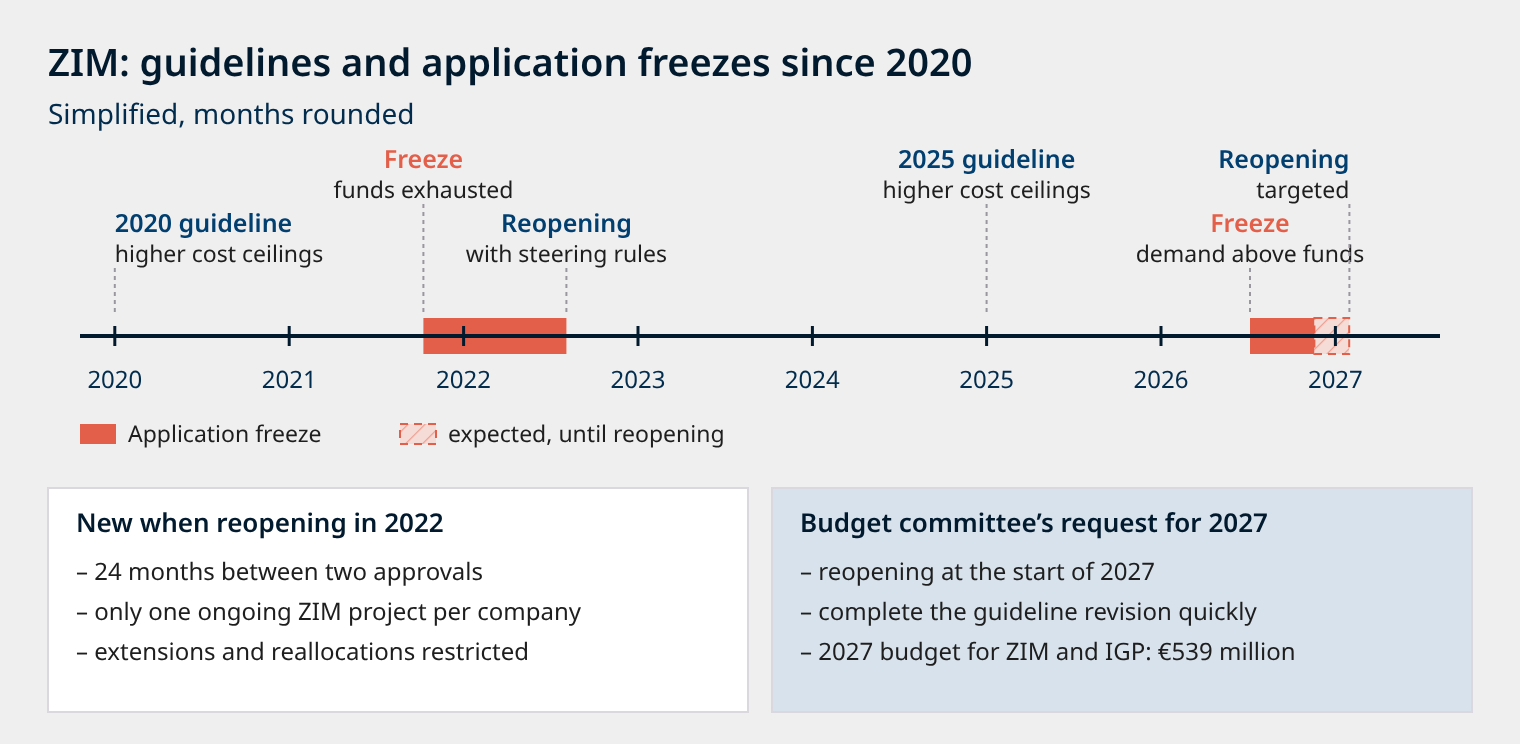
ZIM has had an application freeze before. Looking at the period since 2020 helps to assess what 2027 may bring.
| When | What happened |
|---|---|
| 2020 | New guideline with higher eligible costs per project |
| 2021 | 5,646 applications, 4,185 approvals, average funding of €171,000 per application |
| 7 October 2021 | Application freeze because the 2021 funds were exhausted |
| 3 August 2022 | Reopening with new rules: 24 months between two approvals, only one ongoing ZIM project per company, extensions and reallocations restricted |
| 1 January 2025 | New guideline, including eligible costs of up to €690,000 instead of €550,000 for single projects |
| 7 July 2026 | Application freeze due to increased demand |
| Early 2027 | Reopening targeted, guideline being revised |
The pattern is clear: more generous conditions were followed by strong demand. The 2022 reopening came with rules that steer demand and spread funds over several years. We expect the revised guideline for 2027 to contain similar elements. The ministry has not yet published which ones.
There is also a European deadline. Like most R&D funding programmes, ZIM is based on the EU’s General Block Exemption Regulation. The current version expires at the end of 2026, and the Commission plans to adopt the revised version by the end of 2026. This is another reason to expect changes to many funding guidelines. What the draft provides is explained in our article on the GBER 2027.
AI in applications: transparency is becoming the rule
Generative AI makes writing applications noticeably easier. Funding bodies are responding with transparency rules. In Industrial Collective Research, which is also funded by the Federal Ministry for Economic Affairs and Energy, a new mandatory disclosure has applied since 1 October 2026: applicants state whether they used generative AI, which models and for what purpose. Pure language and translation aids are exempt.
The project management agency also makes clear that AI-generated text must be reviewed critically and that responsibility for the content remains with the applicant. Adopting such text without reflection is not permitted.
ZIM has no such rule so far. Whether the revised guideline will include one is open. It is also not established whether AI-assisted applications contributed to the rise in demand. The ministry cites only increased demand as the reason.
For companies, little changes at the core. The project itself has to convince: a genuine technical advance over the state of the art, a comprehensible risk and a realistic route to market. A well-written text does not replace a technically sound project idea.
What you can prepare now
The months until the reopening can be put to good use. Companies that are prepared can apply early, once the new year’s funds are available.
| What | Why |
|---|---|
| Sharpen the project idea and state of the art | The technical advance and the risk decide on approval. |
| Clarify partners | Most ZIM projects are cooperations, often with a research institution. Coordination takes time. |
| Plan costs, own contribution and liquidity | Funding is only paid after expenditure. More in our article on pre-financing. |
| Do not start early | Orders and development work before the application put the funding at risk. More in our article on early project start. |
| Check alternatives | The research allowance is available independently of ZIM, as are state programmes such as those of the Sächsische Aufbaubank. The same costs must not be funded twice. |
| Follow the news | Date and conditions will appear on zim.de. The project management agencies offer free advice. |
If you are planning several projects, think of them as a sequence: what belongs in a ZIM project, what in the research allowance, what in a later project? More in our article on funding strategy.
Conclusion
Reopening ZIM in early 2027 is politically intended and has been requested by the budget committee. A revised guideline with new steering rules is likely. Companies that prepare their project technically now and plan their funding over several years can act quickly when applications open. We support you in our funding advisory service.
Frequently asked questions
When can I submit a ZIM application again?
The target is the start of 2027. In November 2026 the budget committee asked the Federal Ministry for Economic Affairs and Energy to reopen the programme then. The ministry publishes the exact date and the applicable conditions on zim.de.
What happens to applications received before 7 July 2026?
They can still be approved if they meet the funding requirements and funds are available. Payments for projects that have already been approved continue as normal.
Can I start my project now?
Prepare it, yes. Start it, no. Placing orders or beginning the actual development work before applying puts the funding at risk. Concept work, research and finding partners usually do not count as a project start.
Can I use AI to write the application?
ZIM has no specific rule on this so far. In Industrial Collective Research (IGF), applicants have had to state since October 2026 whether and for what they used generative AI. Responsibility for the content always remains with the applicant.
Sources
- Befristeter Antragsstopp ab 7. Juli 2026, 12:00 Uhr (temporary application freeze), Federal Ministry for Economic Affairs and Energy (BMWE), zim.de, 7 July 2026
- Haushalt 2027: Wirtschaftsetat im Kernhaushalt sinkt (2027 budget), German Bundestag, hib 947/2026, 16 November 2026
- Abgeordnete gegen ZIM-Kürzungen (MPs against ZIM cuts), German Bundestag, hib 695/2026, 9 September 2026
- AIF zum Bundeshaushalt 2027: Positives Signal für die industrielle Forschung, AIF – Allianz für Industrie und Forschung, 13 November 2026
- Expertise belegt: ZIM besonders attraktiv für kleine Unternehmen und Förderunerfahrene (impact study), BMWE, zim.de, 22 May 2026
- Kerninhalte der ZIM-Richtlinie 2025 (key points of the 2025 guideline), Federal Ministry for Economic Affairs and Climate Action, 11 December 2024 (provided by the IHK)
- Förderpraxis und Mittelabfluss des Zentralen Innovationsprogramms Mittelstand im Jahr 2021, Federal Government answer, printed paper 20/261, 13 December 2021
- Antragstellung für ZIM-Förderung wieder möglich (ZIM applications possible again), German Bundestag, hib 443/2022, 9 September 2022
- ZIM applications now possible again, Bayern Innovativ, 5 August 2022
- Rundschreiben vom 27. August 2026: Nutzung von Künstlicher Intelligenz bei der Antragstellung (use of AI in applications), DLR Projektträger, Industrial Collective Research
- State aid: consultation on the draft revised General Block Exemption Regulation, European Commission, Representation in Germany, 25 February 2026
This article is for general information only. It does not replace legal or tax advice on individual cases. The applicable guidelines, funding decisions and statutory provisions in their current version are authoritative.
Compenio editorial team