



Article 7 min read
GBER 2027: what changes for R&D funding

The EU is revising the General Block Exemption Regulation (GBER), the basis for almost all R&D funding programmes. The draft introduces a new category of applied research, higher aid intensities for smaller amounts and relief for young innovative companies.
Almost every grant for a research and development project in Germany is state aid under the General Block Exemption Regulation (GBER). This EU regulation determines which state aid is permitted without individual approval by the Commission and how high it may be. Programmes such as ZIM or the R&D funding of the Sächsische Aufbaubank are based on it.
The current version expires at the end of 2026. The Commission presented a draft revision in February 2026 and discussed a revised draft with the Member States in the summer. For companies that receive R&D funding, it brings several noticeable improvements.
Timeline: what applies when
| When | Step |
|---|---|
| 25 February 2026 | Commission publishes the draft for consultation |
| Summer 2026 | Revised draft discussed with the Member States |
| End of 2026 | Adoption by the Commission planned |
| 1 January 2027 | New GBER to enter into force, under the draft until the end of 2034 |
| 30 June 2027 | End of the six-month adjustment period for schemes under the old GBER |
As of mid-November 2026, the new version had not yet been adopted. All figures in this article are taken from the February 2026 draft and may still change before adoption.
Programmes do not stop on 1 January 2027. The GBER provides for a six-month adjustment period in which the federal and state governments adapt their guidelines. For programmes co-financed by EU structural funds such as the ERDF, the draft even allows Member States to keep the old rules until the end of the 2021 to 2027 programming period. In Saxony, this may apply to many programmes of the Sächsische Aufbaubank.
New category: applied research
Today every funded project has to be split into categories: fundamental research, industrial research, experimental development or feasibility study. Each category has its own aid intensity. In practice, the line between industrial research and experimental development is often hard to draw and has to be justified in detail in the application.
The draft therefore introduces the category of “applied research”. It covers any combination of industrial research and experimental development. Member States can use it as an alternative to the two separate categories.
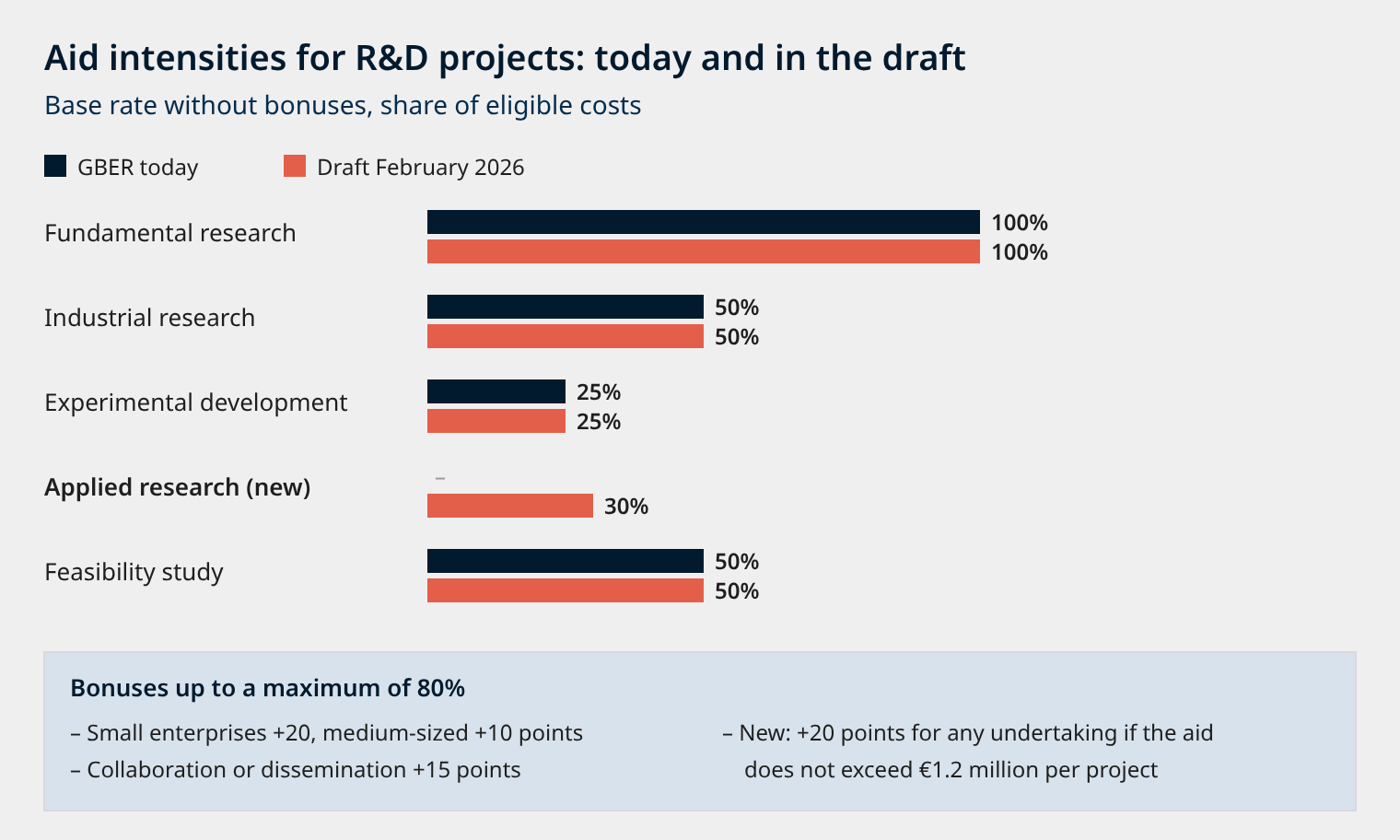
The base rate is 30% of eligible costs, between the existing rates. With the familiar bonuses, a small enterprise reaches 50%, and 65% with effective collaboration, for example with a research institution. Projects that are mainly industrial research still do better under the existing split. The BDI is therefore calling for the applied research rate to be moved closer to that for industrial research.
For planning, this means that classifying a project remains important. Which categories a programme offers is decided by its funding guideline. More on classification by maturity in our article on the Technology Readiness Level.
Higher rates for smaller amounts
So far, only small and medium-sized enterprises (SMEs) receive a bonus of 20 or 10 percentage points. The draft opens this bonus to all companies: if the aid does not exceed €1.2 million per undertaking and project, 20 additional points are possible regardless of size. The same applies to feasibility studies with aid of up to €400,000 per study.
This mainly benefits companies just above the SME thresholds, for example after growth or because an investor makes them a linked enterprise. How shareholdings change SME status is explained in our article on SME status.
The draft also defines “small mid-caps”: companies above the SME thresholds with fewer than 750 employees and turnover of no more than €150 million or a balance sheet total of no more than €129 million. They can, for example, receive innovation aid of up to 25%, which was previously reserved for SMEs.
Young innovative companies and undertakings in difficulty
Undertakings in difficulty are so far largely excluded from GBER aid. This particularly affects research-based start-ups whose losses in the early years use up their share capital. Today, exceptions apply mainly to SMEs in their first three years. More in our article on undertakings in difficulty.
The February draft allows R&D and innovation aid for innovative, unlisted companies up to ten years after registration, even if they are in difficulty on paper. According to the BDI, the revised draft provides corresponding exceptions for innovative start-ups in their first five years. The exact period and the definition have therefore not yet been settled.
The Commission’s recommendation of March 2026 is likely to serve as a benchmark. Under it, a company counts as innovative if, for example, at least 10% of its operating costs are spent on research and development. An innovative start-up is less than ten years old, has fewer than 100 employees and turnover or a balance sheet total of no more than €10 million.
Other changes at a glance
| Topic | Today | Draft |
|---|---|---|
| Innovation aid for SMEs | up to 50%, advisory services up to 100% for no more than €220,000 over three years | also digitalisation costs and small mid-caps (25%), advisory services and digitalisation up to 100% for no more than €300,000 over three years (amount still open) |
| Flat rates | for overheads in R&D projects up to 20%, otherwise mainly with EU funds | simplified cost options for all types of aid, including purely national programmes |
| Notification thresholds | for example €35 million per undertaking and project for predominantly industrial research | unchanged in the February draft; according to the BDI adjusted for inflation in the revised draft, in two stages from 2027 and 2031 |
| Innovation clusters | operating aid for up to ten years | up to ten years, extendable by a further ten years |
The principle that the application must be submitted before work begins remains unchanged. More in our article on early project start.
What this means for your planning
The new GBER sets maximum limits. What a programme actually grants is decided by the federal and state governments in their guidelines. 2027 will therefore be a year in which many guidelines are revised, probably including that of ZIM. Until the new versions are available, individual programmes may pause briefly.
It pays to prepare projects for 2027 technically now and to keep open whether they will be classified as industrial research, experimental development or applied research. Young companies with losses should check whether they will become eligible again. The de minimis rules for smaller amounts of aid are not affected by the revision.
Conclusion
The new GBER makes R&D funding simpler in several respects and more accessible to young and growing companies. The final rules will only be settled on adoption, expected at the end of the year. We will update this article once the regulation has been adopted and take the new scope into account in our funding advisory service.
Frequently asked questions
When will the new GBER apply?
According to the Commission's draft, it is to enter into force on 1 January 2027 and apply until the end of 2034. Adoption is planned for the end of 2026. Details may still change until then.
Do my approved projects remain valid?
Yes. Approved projects keep the legal basis under which they were approved. Aid schemes under the old GBER also remain exempted for six months after it expires, so that the federal and state governments can adapt their guidelines.
Will my funding rate increase under the new GBER?
Not automatically. The GBER sets maximum limits. The rates a programme actually grants are set by its funding guideline. For smaller projects of larger companies and for mixed projects, however, the scope may grow.
Does the de minimis ceiling change?
No. De minimis aid is governed by a separate regulation. Since 2024 its ceiling has been €300,000 over three years, and that regulation runs until the end of 2030.
Sources
- Draft Commission Regulation declaring certain categories of aid compatible with the internal market (new GBER), annex to the communication to the Commission, European Commission, 25 February 2026
- Explanatory memorandum accompanying the proposal for a revised General Block Exemption Regulation, European Commission, 25 February 2026
- State aid: consultation on the draft revised General Block Exemption Regulation, European Commission, Representation in Germany, 25 February 2026
- Review of the General Block Exemption Regulation, European Commission, DG Competition (accessed 17 November 2026)
- Regulation (EU) No 651/2014 (GBER), consolidated version of 1 July 2023, EUR-Lex
- Neuer Entwurf der Allgemeinen Gruppenfreistellungsverordnung (new draft GBER), Forschungsinstitut für Wirtschaftsverfassung und Wettbewerb (FIW), 4 August 2026
- European State Aid Law: New GBER needs to be fit for purpose, Federation of German Industries (BDI), 23 September 2026
- Commission Recommendation (EU) 2026/720 on the definition of innovative enterprises, innovative startups and innovative scaleups, 18 March 2026
- Beihilfekontrolle: EU-Kommission beschließt neue Vorschriften für geringfügige staatliche Beihilfen (new de minimis rules), European Commission, Representation in Germany, 13 December 2023
This article is for general information only. It does not replace legal or tax advice on individual cases. The applicable guidelines, funding decisions and statutory provisions in their current version are authoritative.
Compenio editorial team