



Article 3 min read
Technology Readiness Level: which maturity fits which funding


Funding programmes are aligned with the maturity of a technology, measured in Technology Readiness Levels from 1 to 9. Companies that assess their own level correctly find suitable programmes faster and avoid applications that miss the programme's scope.
Anyone looking for funding for a development project soon comes across an abbreviation: TRL. It stands for Technology Readiness Level. Many funding programmes use it to describe which projects they support.
This article explains the scale in plain terms and shows why the right maturity level often decides which funding is even an option.
The TRL scale in plain terms
The scale runs from 1 to 9. It was originally developed in the space sector and is now also used by the European Commission.
- TRL 1 to 2: basic principles observed, technology concept formulated.
- TRL 3 to 4: concept proven experimentally and validated in the lab.
- TRL 5 to 6: technology validated and demonstrated in a relevant environment.
- TRL 7: system prototype demonstrated in operation.
- TRL 8 to 9: system complete, qualified and proven in actual operation.
How the levels relate to funding categories
EU state aid law distinguishes fundamental research, industrial research and experimental development. In addition, there is funding for market launch and investment. The categories are legally defined, the TRL levels are not. The following mapping is therefore for orientation:
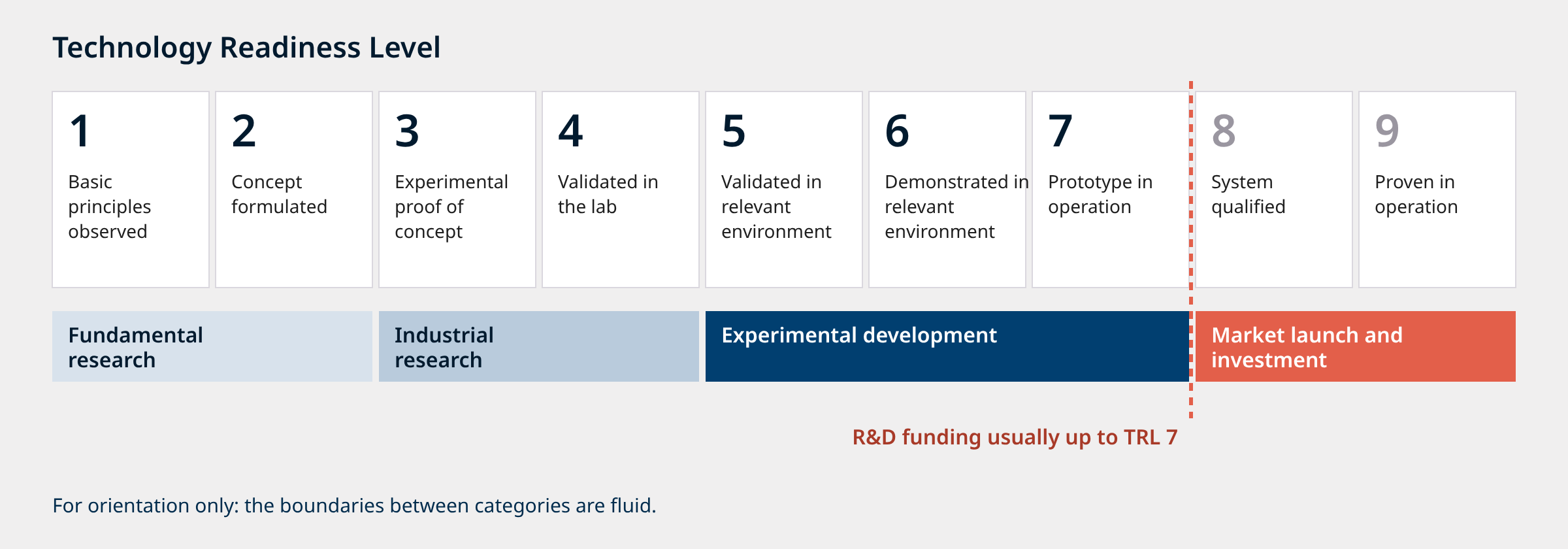
The difference between the categories matters: the closer a project is to the market, the lower the funding rate usually is. Rates for industrial research are generally higher than for experimental development.
Too far or too early
Many R&D programmes fund up to demonstration in operation, roughly TRL 7. Qualifying a finished product and preparing series production are usually no longer included. A project that is essentially ready for the market therefore does not fit R&D funding, even if work remains.
Conversely, investment funding for a technology that is still in the lab usually comes too early. Misjudging your own level costs time on applications that miss the programme’s scope.
The gap between prototype and market
Between a working prototype and a saleable product often lies the most expensive stretch. Many research funding schemes end here, while investors and banks still hesitate. This phase is often called the “valley of death”.
That is exactly why it pays to look at the whole scale: if you know early which levels are still ahead, you can plan follow-up projects and financing in good time.
Assessing your own maturity
Three questions help with an honest assessment:
- Where has the technology been tested so far? On the computer, in the lab, under real conditions or at a customer’s site?
- What is still uncertain? The function itself, performance in operation or only cost and manufacturing?
- What should exist at the end of the project? A proof, a prototype or a saleable product?
Conclusion
The Technology Readiness Level is more than a formality. It determines which funding fits and which stages are still to come. That makes it a common thread for a funding strategy over several years. Our market and technology research provides a sound assessment of the state of the art.
Frequently asked questions
Who determines the TRL of my project?
You first assess the maturity yourself and justify it in the application. The funding body checks whether this assessment and the work plan fit together. A plausible justification matters more than a particularly high or low level.
Can a project cover several TRL levels?
Yes, that is common. A project usually describes the path from one level to the next or the one after. Large jumps across many levels are less plausible.
Do all programmes use the TRL scale?
Not all of them mention it explicitly. But the distinction between research, development and market launch applies almost everywhere and maps well onto the TRL levels.
Sources
This article is for general information only. It does not replace legal or tax advice on individual cases. The applicable guidelines, funding decisions and statutory provisions in their current version are authoritative.
Compenio editorial team