



Article 4 min read
Funding strategy: why your first project should not include everything


Many companies put everything they want to develop into their first funded project. That uses up the topics, because work that has been funded once cannot be funded again. Companies that plan their projects in stages can use funding repeatedly over several years.
A company has a strong idea, a committed team and finally time for a funding application. The obvious move is to put everything into this one project: the new technology, the software for it, the prototype and, ideally, preparations for series production.
That looks efficient, but often wastes potential. This article explains why a funding strategy over several years usually achieves more than one large application.
The typical pattern: one project for everything
First applications often contain every development topic of the coming years. The application becomes large, the work packages diverse and the duration long. For the evaluation this is not necessarily an advantage: a project with a clear research question is easier to justify than one that pursues many goals at once.
But something else weighs more heavily. Whatever is in this first project cannot be funded again in later applications.
Why topics get used up
Funding requires a project to create new knowledge. Once a research question has been addressed with funding, it no longer counts as new. A later application on the same topic will struggle accordingly.
On top of that, double funding is prohibited: the same costs may not be funded from two sources. And aid adds up. EU state aid law limits funding per project and, for de minimis aid, per company over three years.
If you put everything into one project, you use up this scope in one go and cannot draw on it later.
Thinking of funding in stages
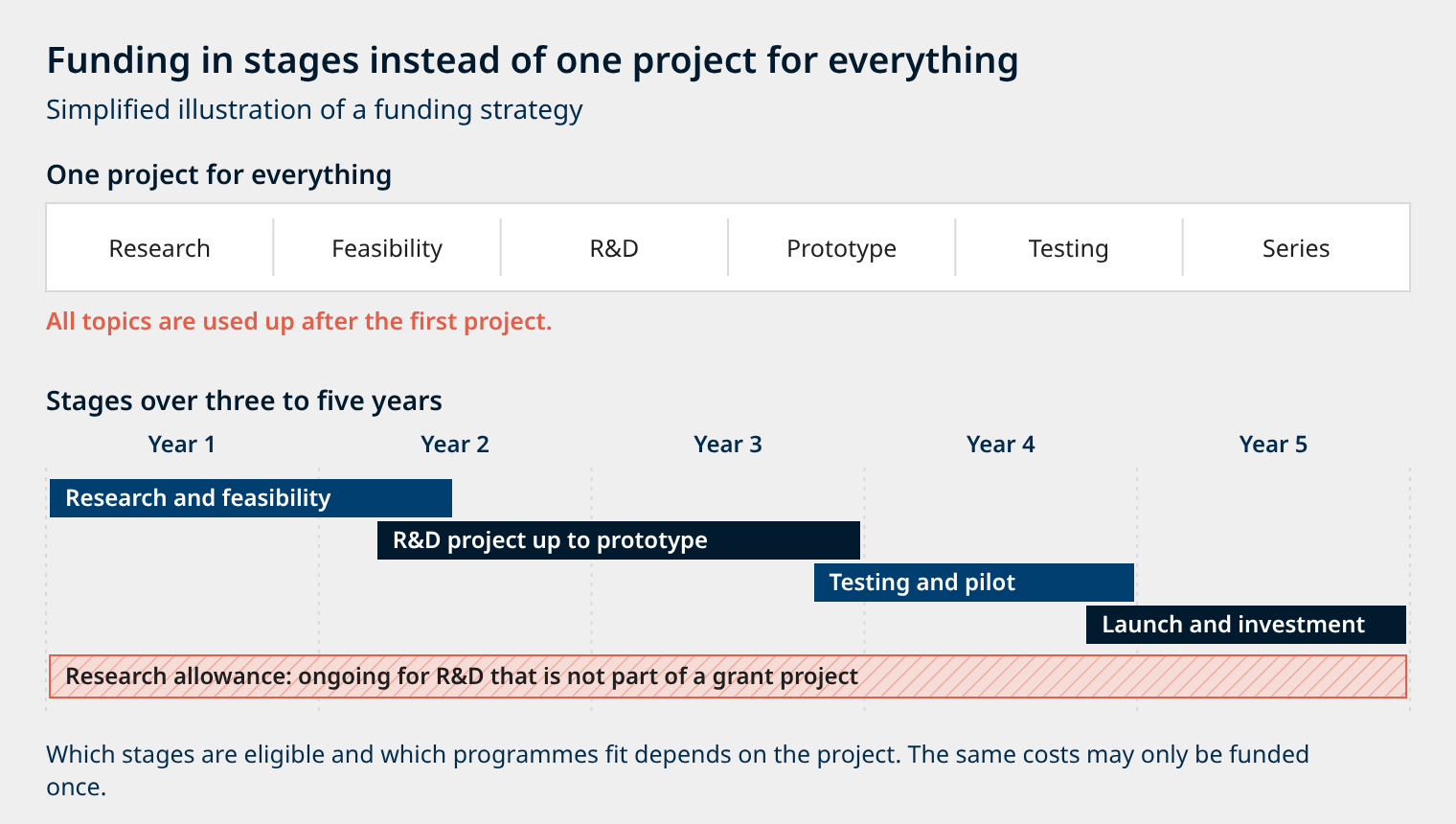
Technology development happens in steps anyway. It starts with research and feasibility, followed by research and development up to the prototype, and finally testing, market launch and investment.
Many of these stages have their own funding approaches. A good funding strategy therefore plans a company’s projects over three to five years and decides which questions belong in which project. Each project gets a clear purpose and builds on the previous one. The stages must follow the actual development steps. Artificially splitting a single project in order to get around funding limits is not permitted.
What else sets limits
Content is not the only finite resource. Staff, own contribution and project durations set limits too:
- Staff: the same employees can only spend their working time once. Parallel projects need their own capacity.
- Own contribution: every funded project requires a share of own funds and pre-financing. A very large project that contains everything at once can strain liquidity.
- Durations: overlapping projects must be clearly distinguishable in content.
The research allowance as a complement
Alongside grants there is the German research allowance (Forschungszulage), a tax incentive. It is not tied to deadlines and can support development work that does not run in a grant project. In a funding strategy it is therefore often the permanent building block, while grant projects carry individual stages. Here too, costs that are already subsidised cannot also be included in the research allowance.
Conclusion
Your first funded project should not contain everything, but the right first step. Companies that arrange their development in stages in advance protect their topics, staff and liquidity and can use funding in a targeted way over years. We are happy to discuss what such a plan could look like for your company in an initial conversation. Get in touch.
Frequently asked questions
Can a topic be funded again after the project ends?
Only if the new project addresses its own, new research question. Work that has already been funded cannot be funded a second time. That is why it pays to think about follow-up steps when preparing the first application.
Can I run several funded projects at the same time?
In principle yes, as long as the projects are clearly distinct in content and no costs are claimed twice. Staff, own contribution and project management then have to cover all projects at once.
How early should I plan the next projects?
Ideally before the first application. That way you can decide what belongs in the first project and what is deliberately kept for later stages.
Sources
This article is for general information only. It does not replace legal or tax advice on individual cases. The applicable guidelines, funding decisions and statutory provisions in their current version are authoritative.
Compenio editorial team