



Article Updated 8 min read
EU funding period 2028 to 2034: what companies should know

The EU is negotiating its budget for 2028 to 2034. Regional funding is to run through national plans in future, research and innovation through a new EU fund. We explain the terms, show who decides and what small and medium-sized enterprises can do now.
Many funding programmes for research, innovation and investment in Saxony are co-financed with EU funds. That is why the negotiations on the next EU budget also affect small and medium-sized enterprises that are planning funded projects today. The debate, however, is full of technical terms and institutions that hardly anyone outside Brussels knows.
This article translates the key terms, shows who decides and explains what companies can do now. It was first published in July 2026 and updated in November 2026.
Key terms explained
| Term | What it is | Why it matters to you |
|---|---|---|
| Multiannual financial framework (MFF) | The EU budget for seven years, here 2028 to 2034 | Determines how much money is available for funding overall |
| Funding period | The period for which funding programmes with EU money are set up | New programmes, new rules, often new application procedures |
| ERDF | European Regional Development Fund | Today finances many state programmes for research, innovation and business investment |
| Transition region | Region with medium economic strength, including the Dresden and Chemnitz regions | Determines how much EU money a region receives and the EU share of funding |
| National and regional partnership plans | Planned single plan per member state for regional and agricultural funding | The federal government would have more say in how much reaches the states |
| Competitiveness Fund | Planned EU fund for innovation, industry and key technologies | Funds through EU-wide calls, not through state programmes |
| Horizon Europe | The EU programme for research and innovation | To be closely linked with the Competitiveness Fund |
| Negotiating box | Compromise proposal from the Council Presidency with concrete amounts for the budget and individual programmes | Shows which direction member states are moving in |
| Own resources | EU revenue, for example from levies or shares of taxes | Must be ratified by all national parliaments, which takes time |
Who decides?
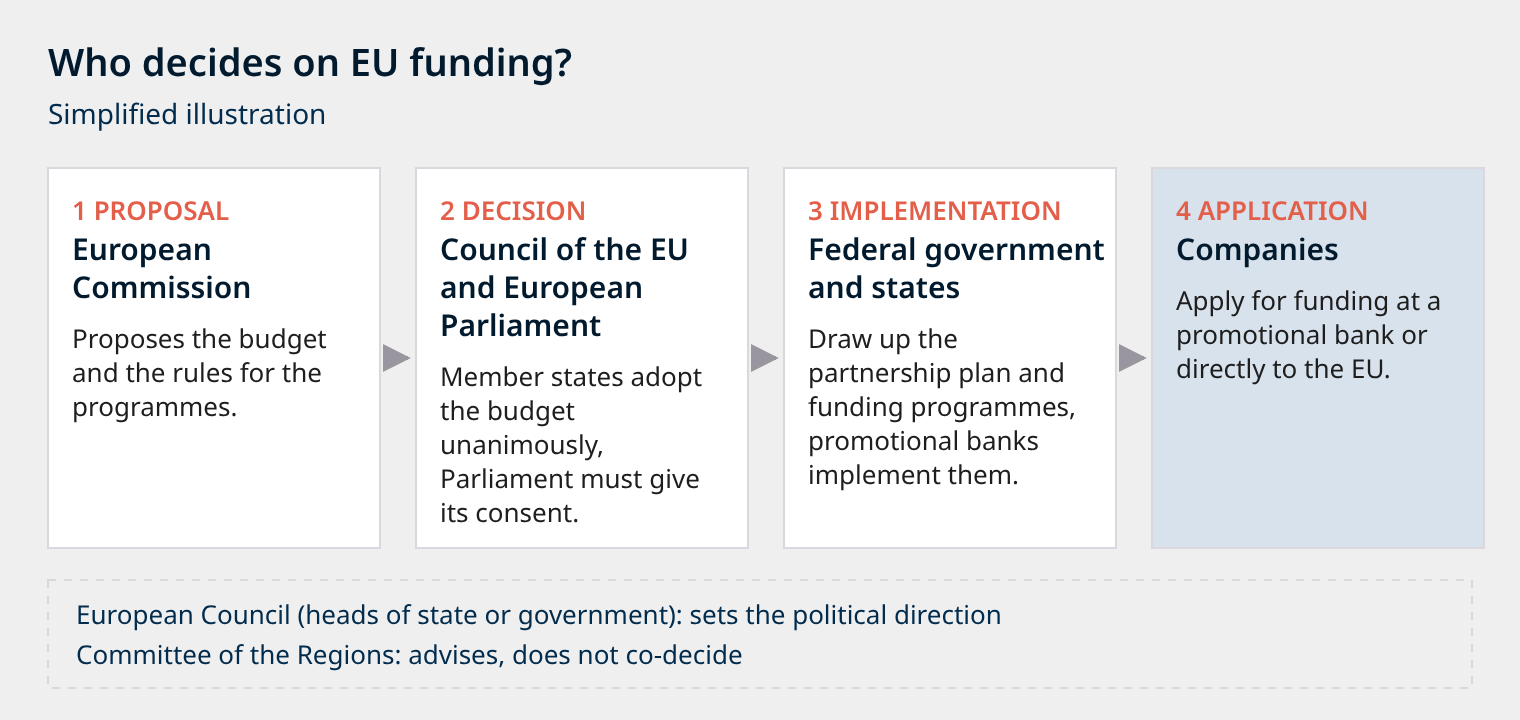
The European Commission makes the proposal. The budget is adopted unanimously by the Council of the EU, made up of member state governments. The European Parliament must give its consent. The political direction is set by the heads of state or government in the European Council. The Committee of the Regions represents states and municipalities but only has an advisory role.
For companies, the last step is what matters: federal and state governments turn the EU rules into their own funding programmes. Only then can companies submit applications, usually to the state or federal promotional bank. In addition, the EU awards some programmes directly (see below).
What the Commission proposes
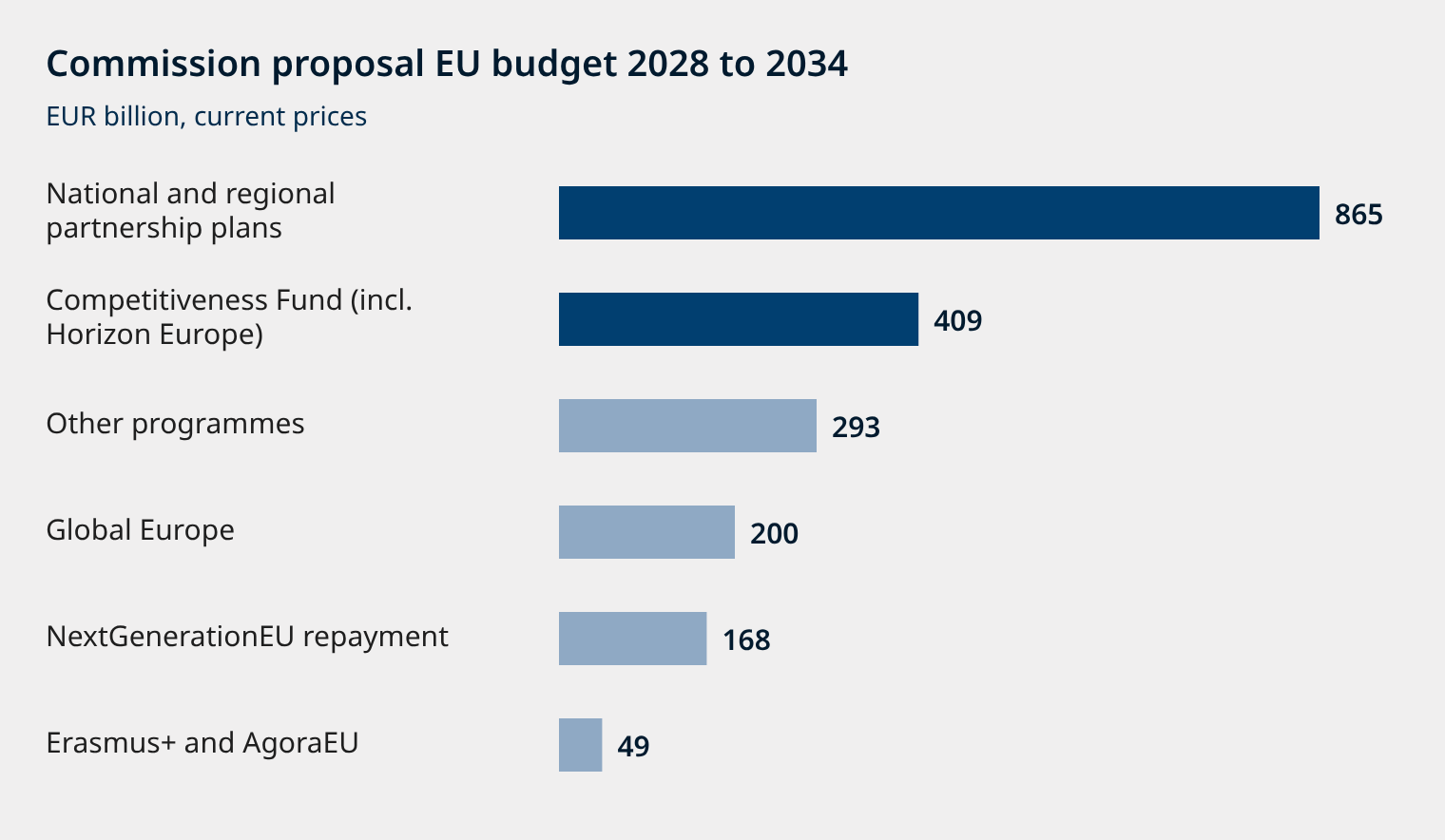
In July 2025 the Commission proposed a budget of around EUR 2 trillion. It is meant to be much simpler: 16 programmes instead of 52.
Two routes to funding
For companies the proposal mainly means two clearly separate routes to EU funding in future.
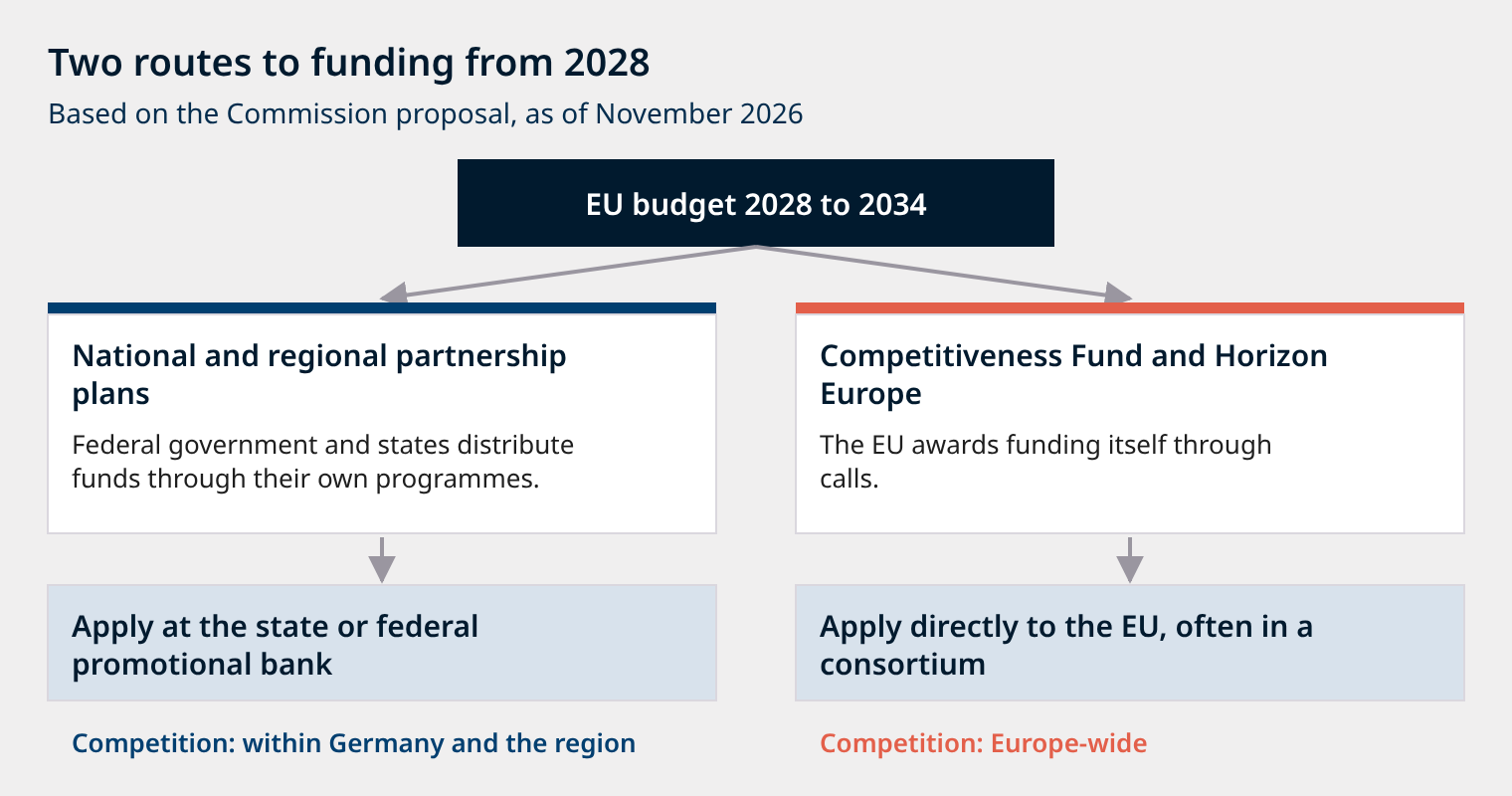
- Through federal and state governments: regional funding, which today includes the ERDF, is to be combined with agricultural funding in one plan per member state. You apply, as before, to the state or federal promotional bank.
- Directly to the EU: the new Competitiveness Fund awards funding for innovation and key technologies through EU-wide calls. Here you compete with companies across Europe, often in consortia with partners from several countries.
What this means for Saxony
For Germany, the Commission proposal provides for a partnership plan with around €68.4 billion in EU funds over seven years. Of this, around €33 billion is earmarked as the minimum budget for agricultural funding, the largest item. Around €27 billion goes to economic, territorial and social cohesion. This second part would likely continue to fund the state programmes for innovation and business investment that today come mainly from the ERDF.
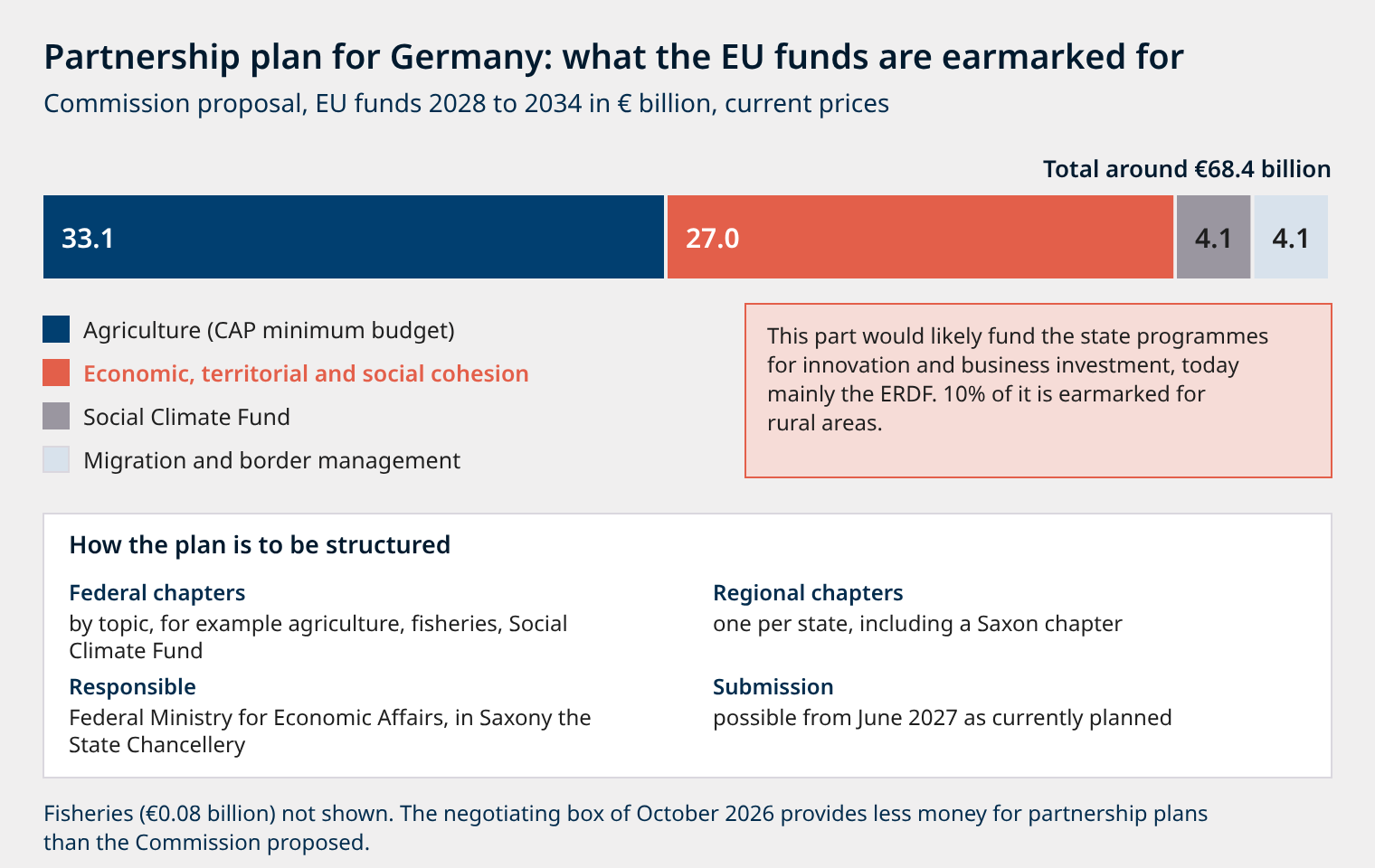
Alongside federal chapters, the plan is to contain regional chapters, including one for Saxony. The Federal Ministry for Economic Affairs is in charge; in Saxony, the State Chancellery coordinates the ministries’ contributions. As currently planned, Germany can submit the plan from June 2027.
For companies this means: which state programmes exist from 2028, and with which priorities, will largely be decided in the Saxon chapter. The figures are based on the Commission proposal. The Council Presidency’s negotiating box of October 2026 provides less money for the partnership plans of all member states than the Commission proposed. How much of this would go to Germany is not yet clear.
Where Parliament, regions and member states disagree
The European Parliament adopted its position in spring 2026. It calls for around 10 % more funding than the Commission and for separate budget lines for regional and agricultural funding instead of a single plan.
The regions also reject the merger. The European Committee of the Regions spoke out against it as early as October 2025. The concern: regions such as Saxony could lose influence and planning certainty if funds are distributed through national plans.
The member states are divided. Some, including Germany, want a smaller budget. Others mainly want to protect regional and agricultural funding. Germany broadly supports the new structure with national plans but wants the regions to be able to negotiate directly.
Update November 2026: where negotiations stand
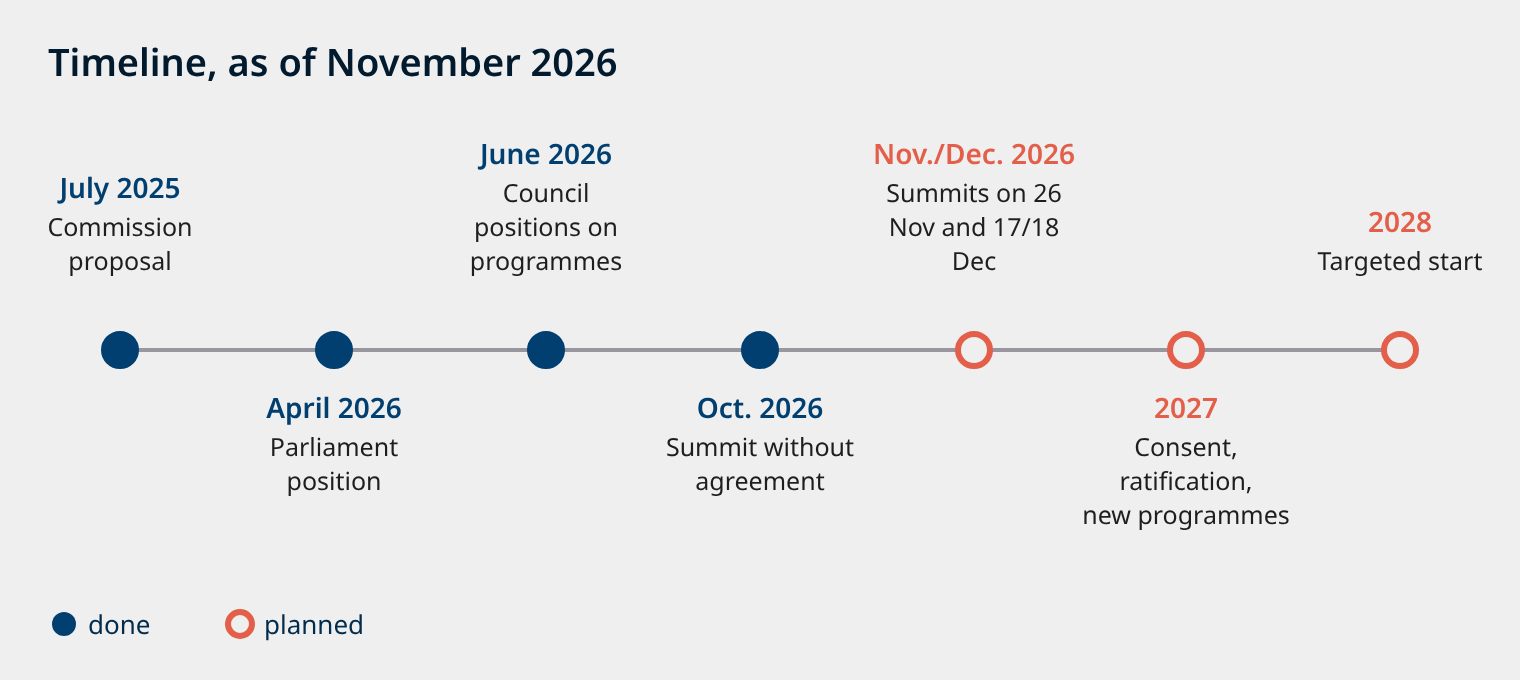
- June 2026: the Council adopted its positions on the partnership plans, the Competitiveness Fund, Horizon Europe and the ERDF rules. The amounts are still open.
- October 2026: the Council Presidency proposed a budget of around EUR 1.62 trillion, about 8 % less than the Commission (in 2025 prices). It includes a minimum amount for less developed regions, but not for transition regions such as Dresden and Chemnitz. If funding there falls well below current levels, member states would have to justify it.
- Mid-October summit: heads of state or government did not reach agreement.
- Next steps: further summits are scheduled for 26 November and 17/18 December 2026. After that, Parliament must give its consent and national parliaments must ratify the own resources.
What you can do now
| When | What | Where |
|---|---|---|
| Now until 2027 | Apply for projects under current programmes while they accept applications | Your state’s promotional bank, for example the Sächsische Aufbaubank, and federal funding programmes |
| Now | Factor a possible funding gap around 2028 into liquidity and project planning | Your own funding strategy |
| Ongoing | Monitor EU-wide calls and look for consortium partners | The Commission’s Funding & Tenders Portal, German National Contact Points for Horizon Europe, Enterprise Europe Network |
| During consultations | Contribute your view on the design of new programmes | Commission consultations under “Have your say”, industry associations and chambers |
Conclusion
The new funding period will noticeably change the funding landscape: more steering by the federal level and the EU, more competition and probably a transition period without new programmes. For small and medium-sized enterprises this means using current programmes in a targeted way and planning the coming years deliberately. We follow the negotiations and put new developments into context in our funding advisory.
Frequently asked questions
Will current funding programmes continue?
Yes. Programmes of the 2021 to 2027 period continue under the existing rules until their funds are committed and projects are completed. When individual programmes stop accepting new applications is decided by the funding bodies.
When will the rules for the new period be fixed?
Member states are aiming for agreement by the end of 2026. Parliament must then give its consent, and the rules for individual programmes still need to be finalised. Concrete funding programmes at federal and state level will follow, probably during 2027 and 2028.
Will there be less funding for companies?
That cannot be said with certainty yet. The member states' proposals so far are below the Commission's. How much reaches Saxony and companies also depends on distribution within Germany.
Where can I find out when new programmes start?
From your state's promotional bank, in the German federal funding database and, for EU programmes, in the European Commission's Funding & Tenders Portal. Many associations and chambers also provide information.
Sources
- EU budget 2028–2034, European Commission
- European Commission news, 16 July 2025
- EU budget 2028-2034: Overview of the Commission's proposal, European Parliamentary Research Service (EPRS)
- Interim report on the proposal for the multiannual financial framework for 2028-2034, European Parliament
- Timeline of the EU budget 2028–2034, Council of the EU
- Negotiating box of the Irish Council Presidency, document ST 13922/26 (October 2026)
- Funding period 2028–2034, information event of 31 March 2026, Saxon State Ministry for Environment and Agriculture
- European regions against the 2028–2034 budget proposal, Eunews (15 Oct 2025)
This article is for general information only. It does not replace legal or tax advice on individual cases. The applicable guidelines, funding decisions and statutory provisions in their current version are authoritative.
Compenio editorial team